The AI writes the entire defense document. The lawyer only reviews it.

In the legal operation of the largest car rental company in Latin America, every accident it never witnessed turns into a lawsuit. What took a lawyer ~4 hours of reading now takes ~1 hour of review.

LocalizaDocumento para contestaçãoDiretoria jurídica · Uso interno

Ação de indenização por danos materiais

R. M. Ferreira e outro Locadora Andrade LTDA e outro

CNJ 0001234-56.2026.8.26.0100 · Vara Cível da Comarca de Barueri/SP

1 Identificação do processo

Valor da causaR$ 18.400,00 p. 10
Ajuizada em14/03/2026 p. 1
Classe / ritoCível, danos materiais e lucros cessantes p. 1
Autores (2)
  • R. M. Ferreira PF
  • A. L. Ferreira PF
Réus (2)
  • T. B. Nogueira PF
  • Locadora Andrade LTDA PJ
Condutor do veículo locadoNão identificado
Placa do veículo locadoABC1D23 p. 7
Contrato de locação nos autosnão consta nos autos

2 O caso

R. M. FERREIRA e A. L. FERREIRA ajuízam ação em face de T. B. NOGUEIRA e LOCADORA ANDRADE LTDA, alegando acidente de trânsito ocorrido em 8 de janeiro de 2026, por volta das 19h20, no cruzamento da Avenida Dom Pedro I com a Rua das Palmeiras, em Barueri/SP. Narram que o veículo locado teria avançado o cruzamento e atingido a lateral esquerda do automóvel dos autores.

3 Local, via e clima

Endereço da inicial geocodificado e conferido contra o do boletim de ocorrência.
The dossierOpening page, rebuilt here in HTML so it stays legible. The case is invented: every name, number and date on the sheet is illustrative.

It reads the case file. You check the page.

0001234-56.2026.8.26.0100página 01 / 340

1 · Identificação do processo

extraído dos autos

Autor / réu

R. M. Ferreira × Locadora Andrade LTDAp. 1

Classe / rito

Cível · danos materiais e lucros cessantesp. 1

Valor da causa

R$ 18.400,00p. 10

Placa / data do acidente

ABC1D23 · 14/03/2026, 21h40p. 7

Condutor do veículo locado

J. C. Almeidap. 4

A field with no source page behind it never enters the document.

First the facts. Then the strategy.

Why is Localiza liable? Súmula 492 of Brazil's Supreme Court (STF): the rental company is jointly liable for accidents caused by whoever rented the car. No account of its own, no witness, no photo: only what is in the case file.

Why does it lose? Art. 341 of Brazil's Civil Procedure Code (CPC): an unchallenged fact is presumed true. A defense that never gets down to the facts loses by default. The game is factual, and factual work costs hours per case.

From here down, every image is a real product screenshot, run on a case from the validation base. The ruling had already come out unfavorable: the dossier prints, from the start, what the defense and the court used. →
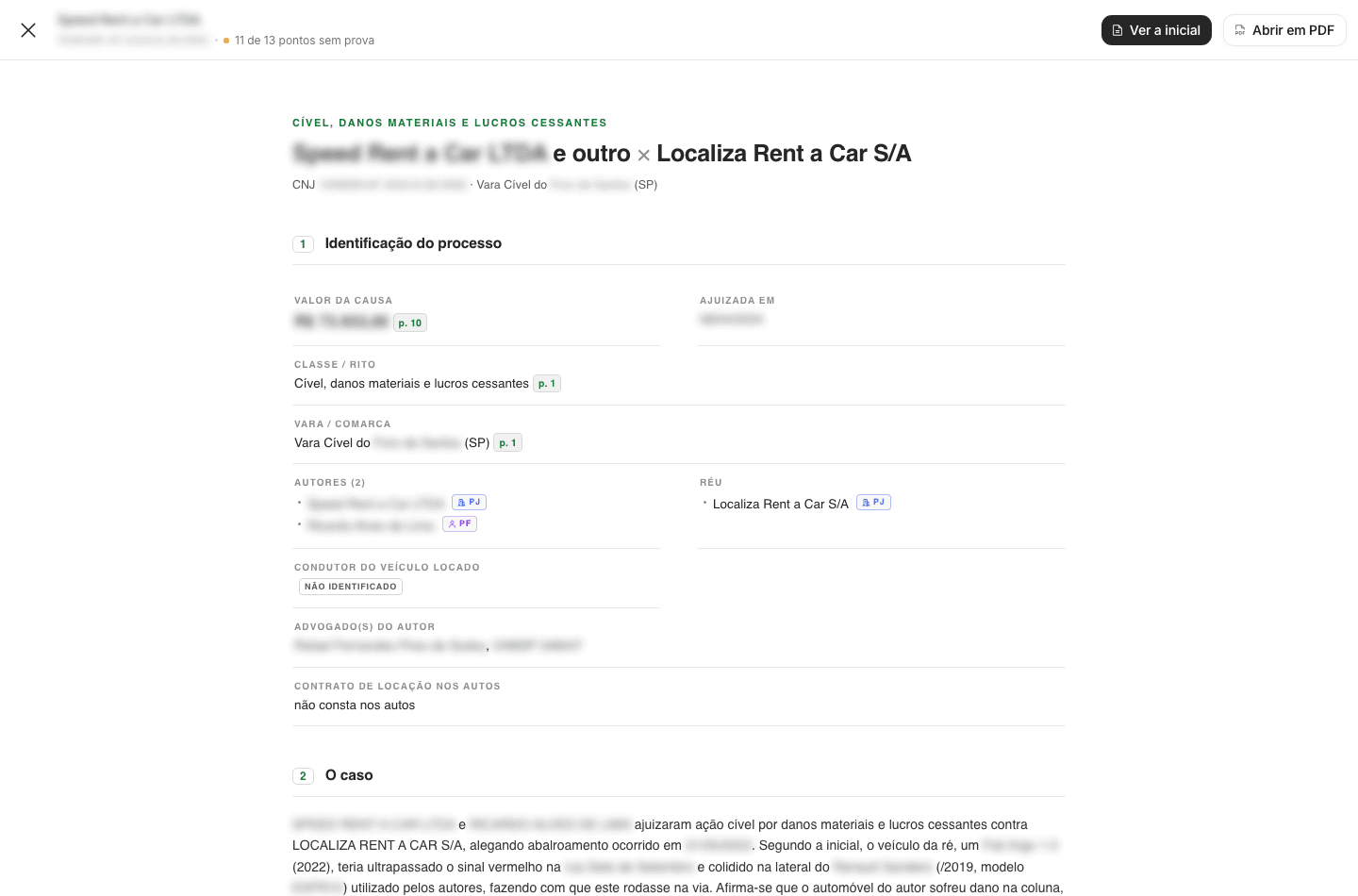
Case identification and opening, generated straight from the case file. Parties blurred in the image.
← The green chips are the source PDF page. The alternative the client tested before cited no page at all: nothing was verifiable.
The structural analyses

Before any legal argument, the case file becomes verifiable data. Three analyses anchor what you saw above:

01

Full case identification

Parties as individuals or companies, co-defendants, claim value, court, lawyers with their bar registration (OAB).

02

Geolocation with map and Street View

The location from the complaint and from the police report, geocoded; divergence measured in meters.

03

Weather, road and signage at the time of the incident

External lookups the case file does not provide.

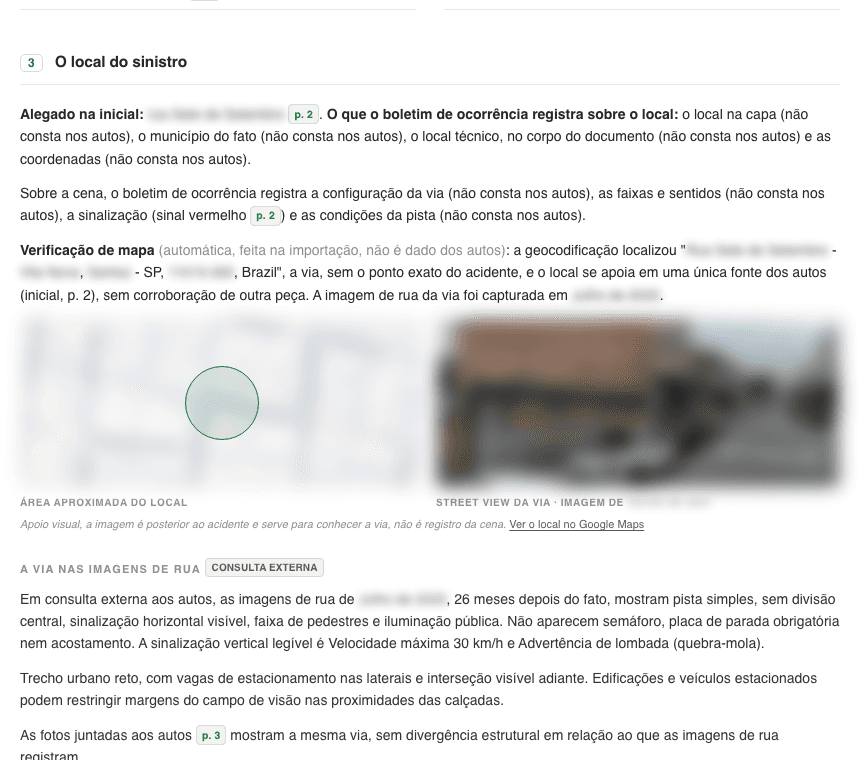
Geocoding runs at import and cross-references the complaint's address with a map and street-level imagery. It is not data from the case file: it is the dossier going out to fetch it. →
Section 3 of the dossier: the incident location, with a geocoded map and street-level imagery of the road.
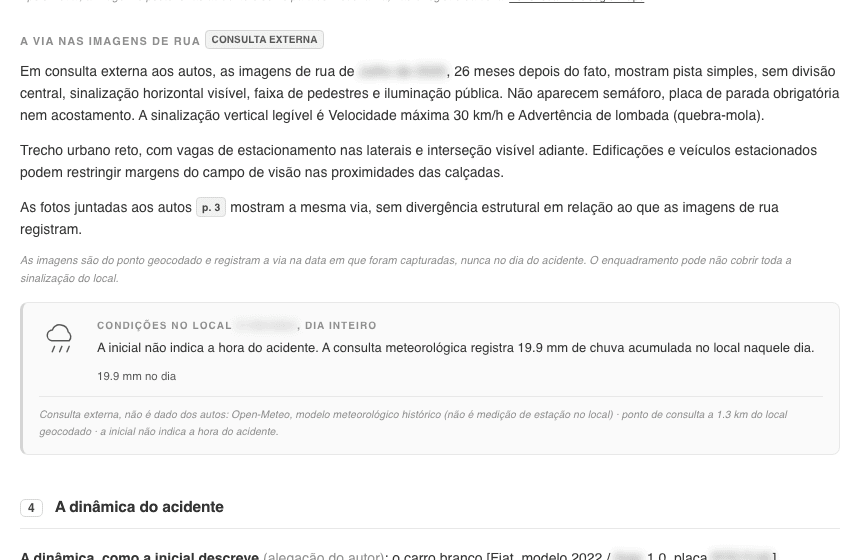
External lookup: the road in street-level imagery and the weather on the day of the incident.
← 19.9 mm of rain that day, from an external lookup. The complaint never places the accident in time, and the topic never comes up at any stage of the case. It is the argument only the dossier would bring.
The merits

With the facts anchored, the dossier moves to what decides the case. The two strongest analyses write the defense strategy:

04

Defense theses and arguments

Cross-portfolio theses plus the catalog matched to each case. It raises doubt, never bad faith.

And the check nobody has the patience to do by hand:

05

Claim-by-claim verification

Every statement in the complaint is checked against the attached documents. What lacks proof gets flagged by name, with its source page.

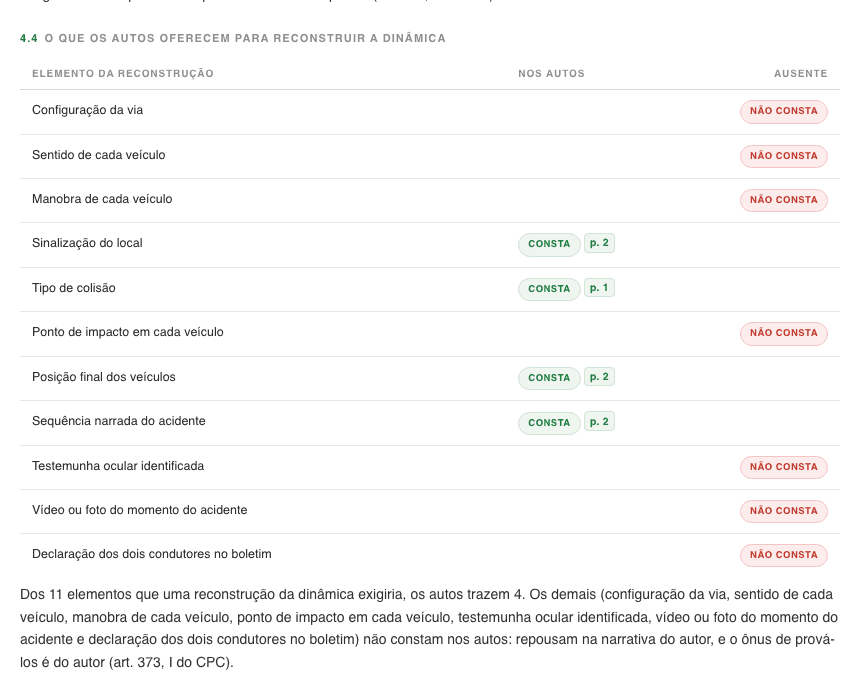
7 of the 11 elements needed to reconstruct the dynamics are missing from the case file. The dossier checks them one by one and names the gaps upfront. →
The dynamics check: what the case file offers for reconstruction, element by element.
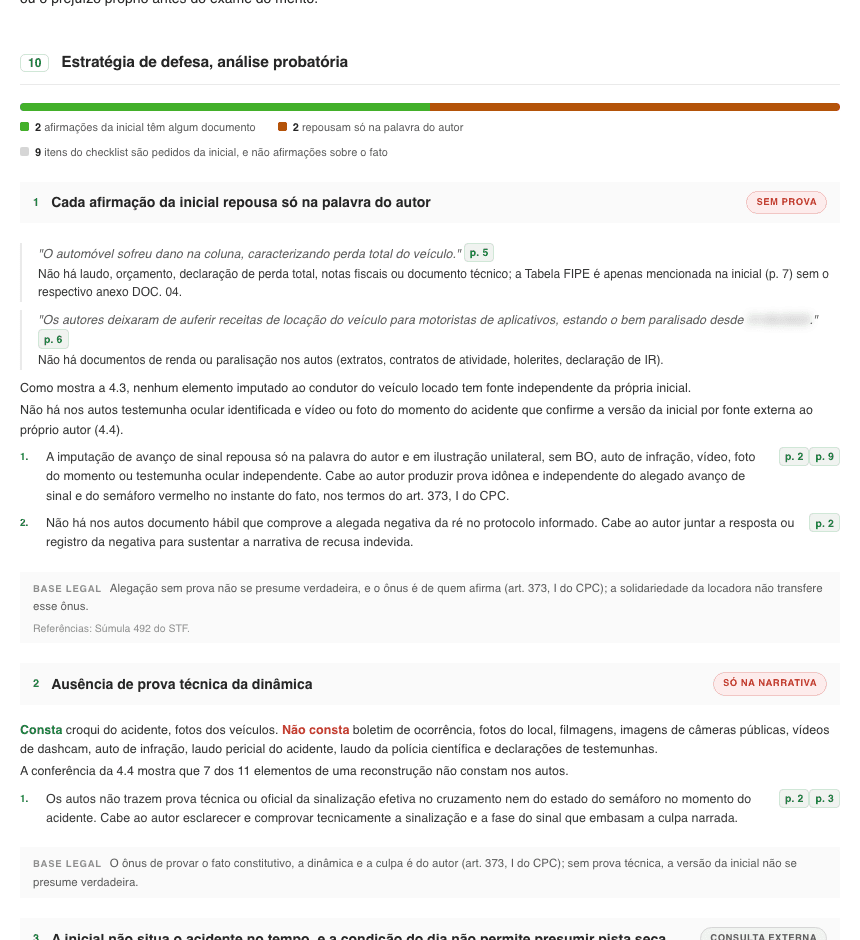
Section 10: defense strategy, with legal basis per thesis.
← The bar opens the strategy: 2 statements backed by a document, 2 resting only on the plaintiff's word. Each thesis ships with its legal basis: art. 373, I of the CPC and Súmula 492 of the STF.
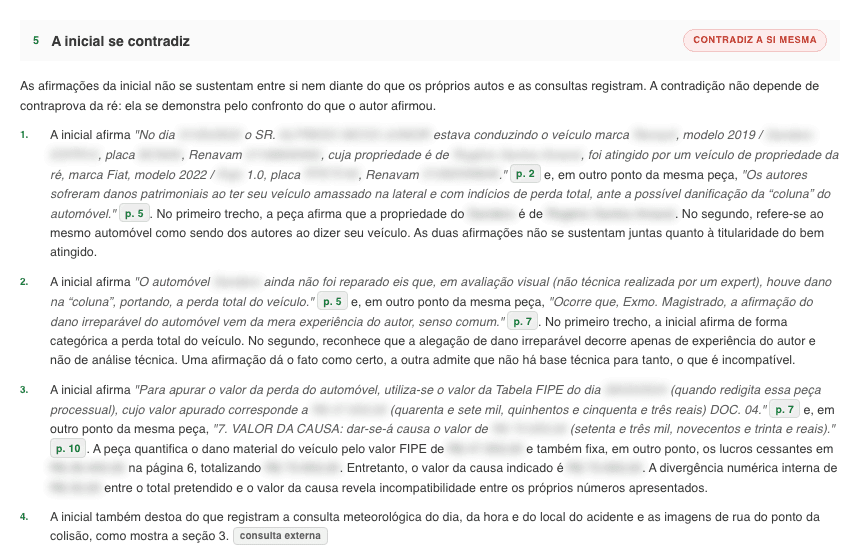
The finding in this case: the complaint contradicts itself, even in the math. R$20.00 of divergence between the total claimed and the stated claim value. →
Section 5: the complaint's internal contradictions, cited and paginated.

Twelve analyses, ranked by strength.

What you saw above is part of a set of twelve analyses per case: first the ones that decided real cases in the pilot base, then the ones that run reliably at scale.

Theses and arguments

Catalog per case, with legal basis.

Car images vs. complaint

Damage zone checked against the narrated collision.

Hypothesis survey

1 to 3 alternative dynamics, stated conditionally.

Accident severity

Classified per CONTRAN Resolution 544/2015.

Map and Street View

Police report location vs. complaint, divergence in meters.

Road and signage

Road conditions at the location and time.

Weather at the time

Weather conditions on the date of the incident.

Document anti-fraud

A pasted-in signature has already turned up in a real case.

FIPE vs. repair quotes

Market value checked against the highest quote.

+ 3 more analysesinjury vs. point of impact, parts vs. impact zone, full identification

The workflow extracts. Code verifies.

The case file goes up at intakefiles land in Tela's Vaultthe workflow fires via APIand from there down, it's the diagram:
Workflow in Telaextraction into literal fieldsasynchronous, ~4 min per casetheses and argumentscar images vs. complainthypothesis surveyseverity (CONTRAN 544)map and street viewroad and signageweather at the timedocument anti-fraudfipe vs. repair quotesinjury vs. point of impactparts vs. impact zonefull identificationRun pulled via the Tela APIoutputs per step · zod contract · CNJ checkedEnrichment in codegeocoding: police report vs. complaint · FIPE · anti-fraudVerification dossierevery field with its source pageDocument ready for the defense
644 automated testsa field without a source page does not make it ina mismatched CNJ number is rejected at import
Tela PlatformVaultNuxtLLMsPDF
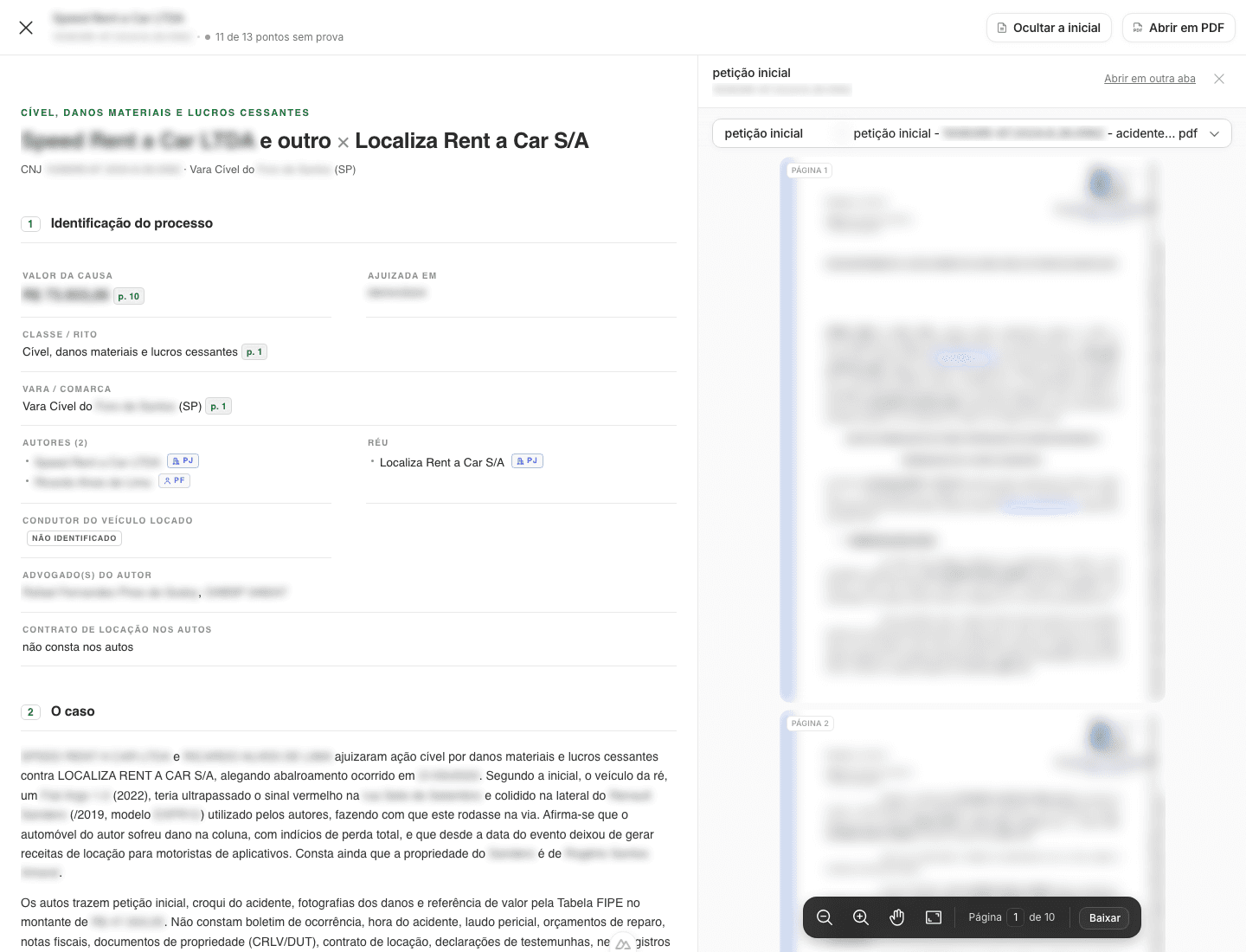
Dossier and source side by side. The case content is blurred in the published image.
← The proof that it's verifiable: click a page chip and the case PDF opens alongside it, at the exact page. Dossier and source side by side.

What took ~4 hours now takes ~1.

Reconstructing a case by reading the entire file, against opening the finished dossier:

manual reading
~4 h
with the dossier
~1 h

Measured in the pilot with the legal team.

100+dossiers generated in the pilot
600+cases analyzed
~75%of assembly time eliminated

Confronted with five decided cases. It found what the defense missed.

Dossier generated from the complaint alone, with no access to the defense or the ruling. Retrospective analysis against cases already decided, point by point.

the document has the pointit does notdossier only, the defense did not raise it
CaseDossierDefenseRulingWhat the column shows
Case 1

The ruling threw the case out on evidence the defense never attacked. Two points were the dossier's alone.

Case 2

Every ground the ruling used was in the dossier, except the one the judge built on his own. One point the defense left out.

Case 3

Full overlap on the three theses. Plus one fact that appears at no stage of the case.

Case 4

The single point the defense skipped is the one that decided it. First row, dossier only.

Case 5

The widest gap of the five. Three points the defense did not raise, two of them used by the ruling.

12 of 20dossier points the filed defense also raised
8 of 20points the dossier had alone, the defense did not raise them
14 of 18grounds the rulings stood on that the dossier already held
5 of 5cases with a finding only the dossier had

Counted over the fact points of the matrices. Column order follows the order of the case file, complaint to ruling. In one of the five, the argument that decided the case was not in the filed defense; it was printed in the dossier.

"The dossier was an extremely positive surprise for the team."

Localiza LegalOps team